Godrej MSR City — Phase 3 master plan image
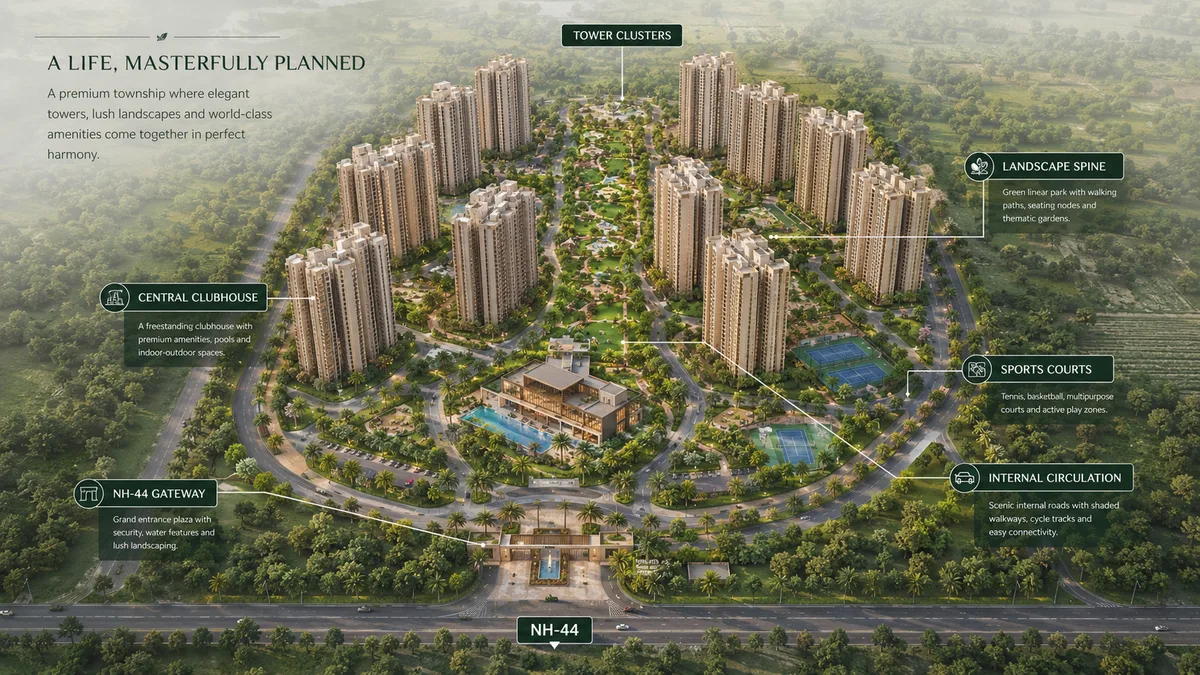
Phase 3 is laid out as 3 buildings comprising 15 towers of Ground+15 within the 62-acre Godrej MSR City township. The master plan follows a high-rise, high-open-space logic: tall, slim towers concentrate the building footprint, freeing the ground plane for a landscaped central spine, sports courts, water features, and the clubhouse precinct. The phase plugs into a master development that already carries Phases 1 (Barca) and 2 (Barca II) in delivery, so its shared systems are designed at township scale rather than per block.
The township framework
Phase 3 does not sit on an isolated parcel; it plugs into a master-planned 62-acre development. That distinction shapes everything about the layout. A standalone three-acre project has to fit its clubhouse, parking, and open space onto a single small footprint; a 62-acre township plans those systems once, at scale, and distributes them across phases. For Phase 3, this means the amenity base is township-scale — a grand clubhouse and a full sports and wellness programme, not a partial amenity floor; the open space is part of a continuous landscaped network rather than a token setback; the infrastructure — sewage treatment, water recharge, waste processing, security — is sized for the master development and serves Phase 3 as one of several phases; and the road and pedestrian network connects Phase 3 into the township's internal circulation and its NH-44 approach.
| Township parameter | Value |
|---|---|
| Master development | Godrej MSR City |
| Total area | ~62 acres |
| Locality | Shettigere, Devanahalli, North Bengaluru |
| Developer | Godrej Properties Ltd (JV with MS Ramaiah Ventures LLP) |
| Phases launched | Phase 1 (Barca), Phase 2 (Barca II) |
| This phase | Phase 3 — 3 buildings / 15 towers / G+15 |
Phase 3 built form - 3 buildings, 15 towers, G+15
The governing built form for Phase 3 is 3 buildings comprising 15 towers, each Ground + 15 floors. The arrangement groups the 15 towers into 3 building clusters, which allows the layout to maximise inter-tower spacing — grouping towers into clusters, rather than packing them in a uniform grid, opens sight lines and protects daylight, cross-ventilation, and privacy between blocks; preserve a central open spine — concentrating the towers toward the edges of the phase footprint frees the centre for the landscaped park, water features, and the amenity courts; and work within the airport height envelope — the G+15 height sits inside the Airports Authority of India clearance band that governs building heights in the Devanahalli airport approach zone, so the towers achieve scale without breaching the corridor's height regime.
| Phase 3 built parameter | Value |
|---|---|
| Buildings | 3 |
| Towers | 15 |
| Floors | Ground + 15 (G+15) |
| Configurations | 2 BHK (1,201 & 1,241 sq ft); 3 BHK (1,603 & 1,864 sq ft) |
| Format | Premium high-rise on landscaped ground plane |
Open space and landscape
The defining move of a high-rise master plan is the trade of vertical height for horizontal openness. Because the towers rise to G+15, the building footprint occupies a smaller share of the ground than a low-rise scheme would, and the recovered ground plane becomes the township's landscaped network — the part of the development that residents actually live in at ground level.
The Phase 3 landscape integrates into the township's green framework:
- a central landscaped park and green spine running through the phase, with shaded walkways and seating courts;
- water features and rain-fed landscape elements that double as micro-climate and stormwater management;
- dedicated activity zones layered across the open space — children's play areas, a toddler zone, a senior citizens' plaza, an amphitheatre, and a pet park;
- sports surfaces woven into the landscape — tennis, basketball, futsal, a skating rink, and outdoor fitness stations;
- jogging, walking, and cycling tracks threading the green network;
- a reflexology pathway and yoga/meditation deck for wellness use.
The intent is a ground plane that is walkable end to end, with the towers reading as a backdrop to a continuous landscape rather than as the dominant feature. The amenities page details the full indoor and outdoor inventory.
The clubhouse precinct
The social anchor of the master plan is the township clubhouse — a dedicated amenity building rather than a borrowed floor inside a residential tower. Positioning the clubhouse as a freestanding precinct does two things: it isolates amenity noise and footfall from apartment owners, and it gives the indoor programme — the gym, the pool, the games rooms, the multipurpose hall, the co-working lounge, the mini theatre, and the spa and wellness rooms — genuine programmable space. The amenities page details the full indoor and outdoor inventory; the master plan's role is to site the clubhouse centrally enough that every Phase 3 tower has a short, walkable, traffic-free route to it.
The airport-zone design constraint
One design constraint shapes the Phase 3 layout more than any other, and it is invisible in the brochure: the township sits inside the Kempegowda International Airport approach zone. Building heights this close to a major airport are governed by Airports Authority of India (AAI) clearances, which cap the permissible height of any structure under the flight path. The G+15 envelope for Phase 3 is set to sit within that AAI band — high enough to achieve the density and the views that make the high-rise format worthwhile, but within the limit that the airport corridor imposes. The height-clearance regime for the Devanahalli approach zone is administered by the Airports Authority of India.
For a buyer, this is a quiet but meaningful point of confidence. A developer building this close to the airport must design around the height regime from the outset; a layout that pushes against it risks approval delays or post-hoc redesign. Godrej's G+15 format is a deliberate response to the constraint — it accounts for the airport zone in the master plan rather than discovering it later. It is also why the corridor's skyline stays relatively open: the height cap keeps the towers in a consistent band, which preserves the long-range views and the uninterrupted horizon that are part of the location's appeal.
How the phase fits the township build-out
Phase 3 is the third residential tranche of a phased 62-acre development, and the phasing logic matters to the master-plan read. Phasing a township — rather than launching all of it at once — lets the developer sequence construction, calibrate inventory release to demand, and refine each phase against the lessons of the last. The earlier phases (Barca and Barca II) are in delivery, which means the township's spine infrastructure — the main internal roads, the security perimeter, the STP and water systems, and the landscape framework — is already being established as Phase 3 comes to market.
| Phase | Status | Role in the master-plan build-out |
|---|---|---|
| Phase 1 (Barca) | Launched (2025) | Established the township's first residential cluster and core infrastructure |
| Phase 2 (Barca II) | Launched (2025) | Extended the residential footprint within the master plan |
| Phase 3 | Pre-launch (EOI mid-2026) | Adds 3 buildings / 15 towers / G+15 to the township |
For a Phase 3 buyer, the practical advantage of buying into a phased township at this stage is that the master-development infrastructure is no longer a promise — it is visibly under way in the earlier phases. The risk that the township's shared systems never materialise, which a buyer faces in a single-phase greenfield launch, is substantially lower here.
Circulation and access
The site layout separates vehicular and pedestrian movement — a planning discipline that becomes more valuable at township scale, where the volume of both is higher.
- Vehicular access enters from the township's NH-44 approach and feeds an internal road network connecting the phases. Drop-off and parking access are handled at the tower clusters.
- Pedestrian zones around the clubhouse, the central park, and the children's play areas are kept traffic-free, so residents move between their tower, the amenities, and the open space without crossing driveways.
- Parking is covered, in basement and podium levels, keeping surface parking off the landscaped ground plane and preserving the open-space ratio. Electric-vehicle charging provision is built into the parking infrastructure.
Township infrastructure
The master plan integrates the sustainability and utility systems at township scale:
| System | Role |
|---|---|
| Sewage Treatment Plant (STP) | Treats township wastewater; treated water returned to landscape irrigation |
| Rainwater harvesting & recharge pits | Manages the campus water cycle and recharges the local water table |
| Organic waste converter | On-site processing of wet waste |
| Solar-assisted common-area lighting | Reduces the maintenance-side energy load |
| EV-charging provision | Built into basement/podium parking |
| Multi-tier security | CCTV coverage, boom-barrier access, managed single-gateway perimeter |
| Power backup | Common areas and apartments |
Sizing this infrastructure once for the 62-acre development, rather than retrofitting it per phase, is the efficiency dividend of a master-planned township — and Phase 3 inherits a system that has been proven across the earlier phases.
How the master plan reads for a buyer
For a Phase 3 buyer evaluating the layout, three things matter most.
Open space. The high-rise, clustered-tower approach is what makes the generous ground-level landscape possible — buyers are trading a higher floor count for a more open, walkable, amenity-rich ground plane.
The township platform. Phase 3 buys into amenities, infrastructure, and management at 62-acre scale, which is a structurally better base than a standalone small project can offer — both for daily living and for long-run resale, because a large branded township holds its identity and management standard over time.
The airport-envelope design. The G+15 height is a deliberate response to the airport approach zone. A buyer this close to Kempegowda International Airport benefits from a layout that has accounted for the height regime from the outset, rather than one that pushes against it.
The final, surveyed master-plan drawing — exact tower positions, the clubhouse footprint, the open-space ratio, and the parking counts — is confirmed on the official Phase 3 plates at launch. Buyers registering at the EOI stage receive the master-plan walkthrough as part of the site visit; use the contact page to register interest and reserve a slot once the EOI window opens. The floor-plans page details the 2 and 3 BHK configurations.
Layout conventions are one of the few things that genuinely travel with a builder.
Godrej MSR City — Phase 3 master plan FAQ
How is the Godrej MSR City — Phase 3 master plan laid out?
Phase 3 is laid out as 3 buildings comprising 15 towers of Ground+15 within the 62-acre Godrej MSR City township at Shettigere. The 15 towers are grouped into 3 building clusters, concentrating the building footprint toward the edges and freeing a central open spine for the landscaped park, water features, sports courts, and the clubhouse precinct.
How does Phase 3 fit the wider Godrej MSR City township?
Phase 3 plugs into a master-planned 62-acre development. Because Phases 1 (Barca) and 2 (Barca II) are already in delivery, the township's spine infrastructure — internal roads, the security perimeter, the STP and water systems, and the landscape framework — is already being established as Phase 3 comes to market, so the shared systems are visibly under way rather than only promised.
Why is Phase 3 limited to G+15?
The G+15 height sits inside the Airports Authority of India clearance band that governs building heights in the Devanahalli airport approach zone. The format achieves the density and the views that make a high-rise worthwhile while staying within the limit the airport corridor imposes — a constraint any developer building this close to Kempegowda International Airport must design around from the outset.
How much open space does the Godrej MSR City — Phase 3 master plan have?
The high-rise, clustered-tower format concentrates the building footprint and frees the ground plane for a landscaped central spine, sports courts, water features, and the clubhouse precinct. Parking is sent to basement and podium levels, keeping surface parking off the landscaped ground plane. The final open-space ratio and tower positions are confirmed on the official Phase 3 plates at launch.
Where is parking at Godrej MSR City — Phase 3?
Parking is covered, across basement and podium levels, keeping surface parking off the landscaped ground plane and preserving the open-space ratio. Electric-vehicle charging provision is built into the parking infrastructure. Pedestrian zones around the clubhouse, the central park, and the children's play areas are kept traffic-free.
Talk to the Godrej MSR City — Phase 3 team
Register your interest for the master-plan walkthrough, priority unit selection, and the indicative cost sheet for the 2 and 3 BHK apartments at Shettigere, Devanahalli.
Contact us